40-gallon liquid system
The tank and high-flow application system are designed for agricultural spraying. Confirm the pump and nozzle setup against your intended application rate and acreage.

A Ceres Air agricultural platform for spraying, spreading, and configured lifting work. Explore the aircraft, understand the equipment, and build your next step with AerSol.
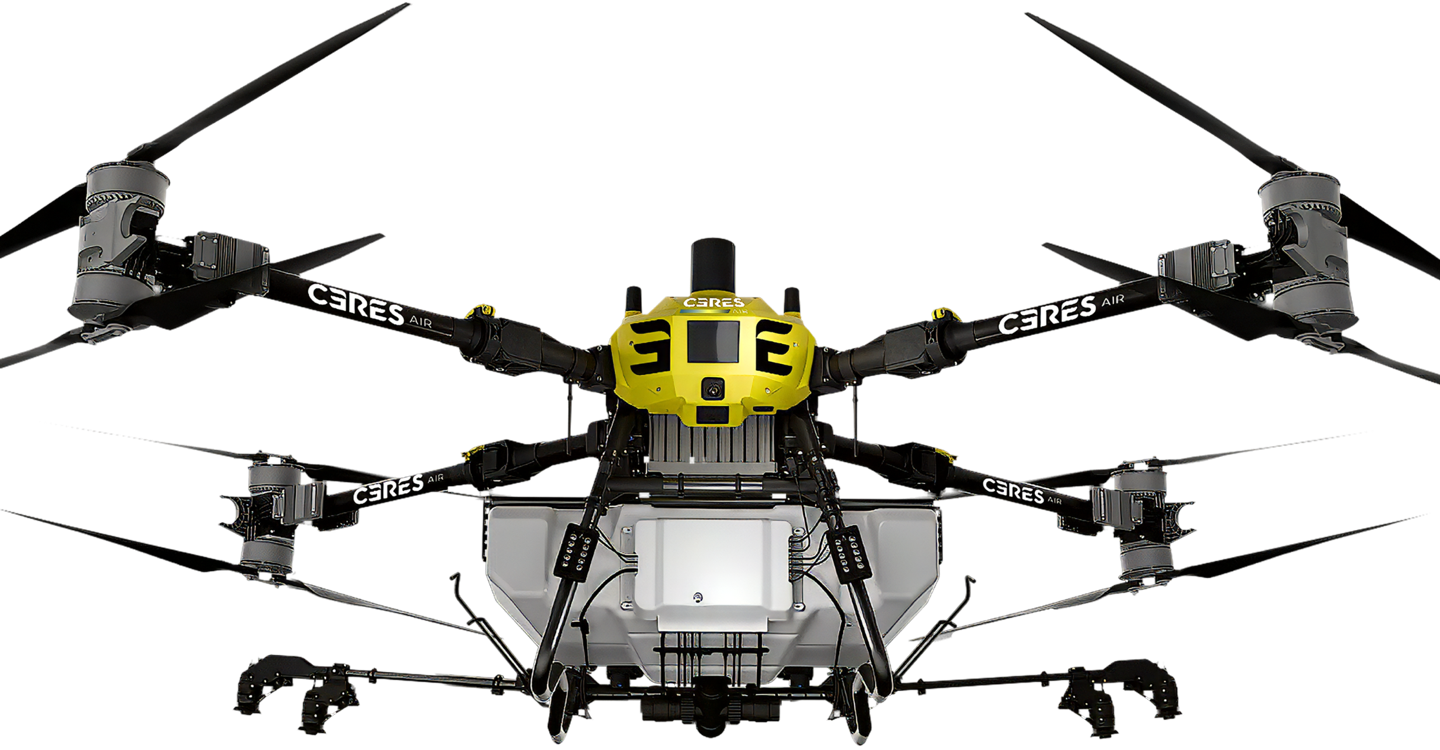
Manufacturer-listed figures describe capabilities under the relevant configuration and conditions. Actual output depends on application rate, payload, field layout, weather, battery management, and ground support.
Start with what your land and operation need. The C40 pairs a high-capacity aircraft with detachable payload equipment so you can explore liquid application, dry-material spreading, or a lifting setup.
AerSol helps you compare the aircraft, modules, charging, field logistics, and support as one working system. A product inquiry is the beginning of a conversation, not a payment or a commitment to purchase.
Watch the Ceres platform video ↗The tank and high-flow application system are designed for agricultural spraying. Confirm the pump and nozzle setup against your intended application rate and acreage.
A rear array of four atomizing centrifugal nozzles supports a broad application pattern. Ceres describes the arrangement as supporting canopy penetration, leaf coverage, and reduced mist interference.
Centrifugal atomization provides a manufacturer-listed droplet range of 2–20 mils. Select settings around the application and product requirements rather than assuming one setup suits every field.
Corrosion-resistant impeller construction and an expanded pump chamber are intended to support demanding, high-flow application work, including orchard use.
Two electromagnetic flow meters provide live monitoring for application control. Ceres describes non-contact sensing intended to limit exposure and corrosion.
The modular arrangement supports a change from spraying to spreading. Ceres lists a maximum spreading rate of 551 lb/min; confirm the material, module, and operating setup.
Ceres’ page lists up to 18 gal/min in its headline specifications and an 11 GPM pump in its feature description. Ask AerSol to confirm the exact pump/nozzle configuration and applicable flow figure in your package proposal.
Coaxial dual rotors combine eight propellers across four axes. Ceres lists 375 lb maximum thrust per axis and a maximum speed of 66 ft/s. These are platform limits, not recommended application settings.
The sensing system combines LiDAR, 360° millimeter-wave radar, and rear-facing radar for environmental awareness and obstacle detection. Ceres lists LiDAR sampling at up to 300,000 points per second.
The listed camera field of view is horizontal ±45° and vertical ±85°. Maximum image transmission is listed at 2 km; usable range depends on conditions and the approved operating plan.
70-inch propellers use a large-diameter airfoil and carbon-fiber construction for stiffness and thermal stability.
Ceres lists high-torque motors at 187 lb maximum thrust each, paired with 350 A electronic speed controllers.
The manufacturer lists emergency shutdown protection and low-battery behavior among the platform’s safety features. Review the supplied operating documentation and procedures with the team.
The rotor layout is intended to provide strong downdraft and a wide spray swath. Coverage and distribution still depend on the field, weather, setup, and application settings.
Discuss the lifting module, load characteristics, route, and operating requirements with AerSol before planning cargo work.
A triaxial force sensor supports automatic attitude correction intended to reduce load swing during flight.
The lifting system uses force-sensor feedback to monitor the load and support overload management.
Ceres describes an automatic-flight workflow in which the operator defines loading and unloading points and commands navigation between them.
The specification table lists 396 lb lifting payload and a standard 15 m cable. Descriptive copy rounds the lift figure to 397 lb; confirm the applicable rated load and configuration.
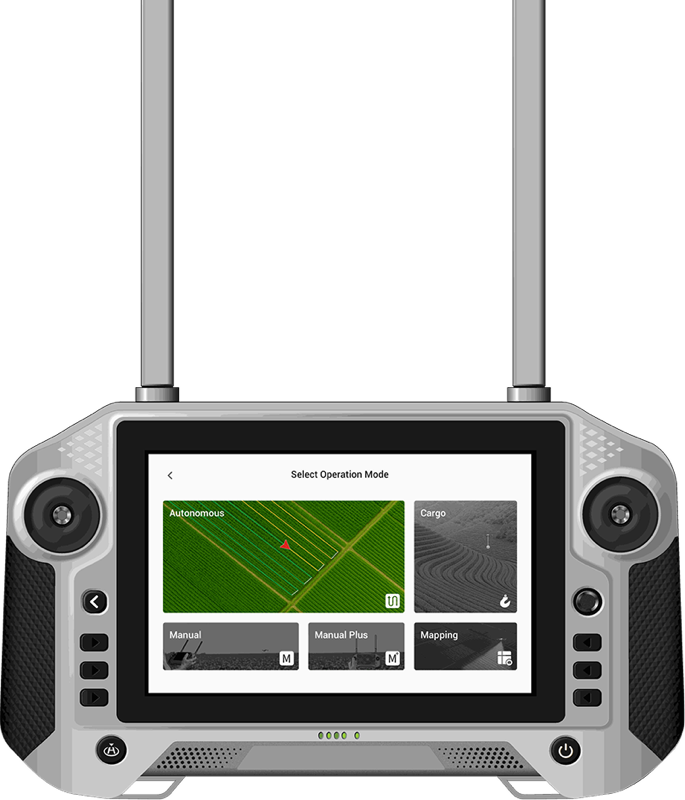
Ceres describes a 6-inch high-brightness display, backlit/customizable buttons, and an internal battery plus two external batteries. It advertises a 25% brightness increase and approximately seven hours of use. The page references both HD402 and RC8P; confirm the controller supplied.
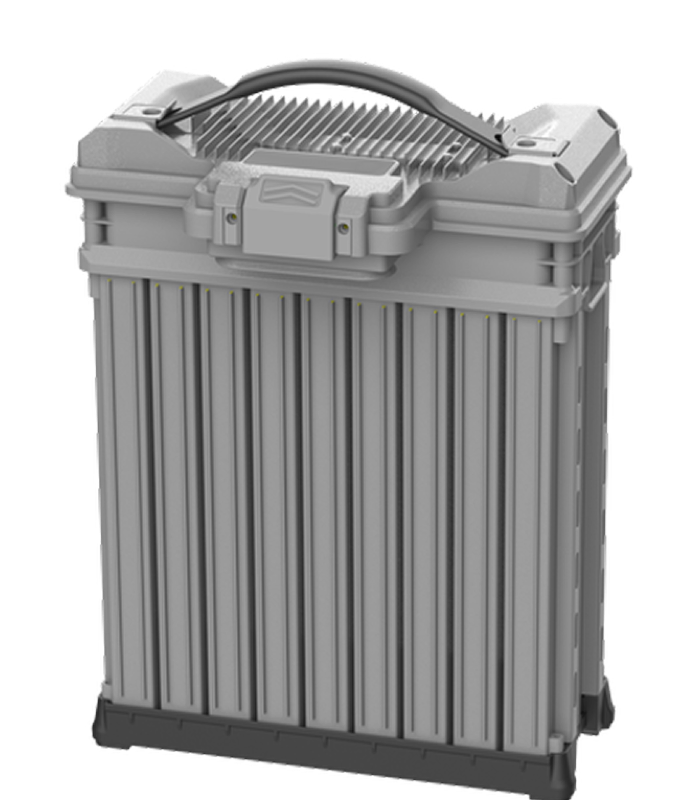
The manufacturer describes a Dual 18S2565Wh battery platform with 38 Ah capacity, 140 A charging current, a listed weight of 37 lb, and triple air-channel cooling for heat management. Its page states 1,500 charge cycles under warranty; confirm the applicable warranty terms before purchase.
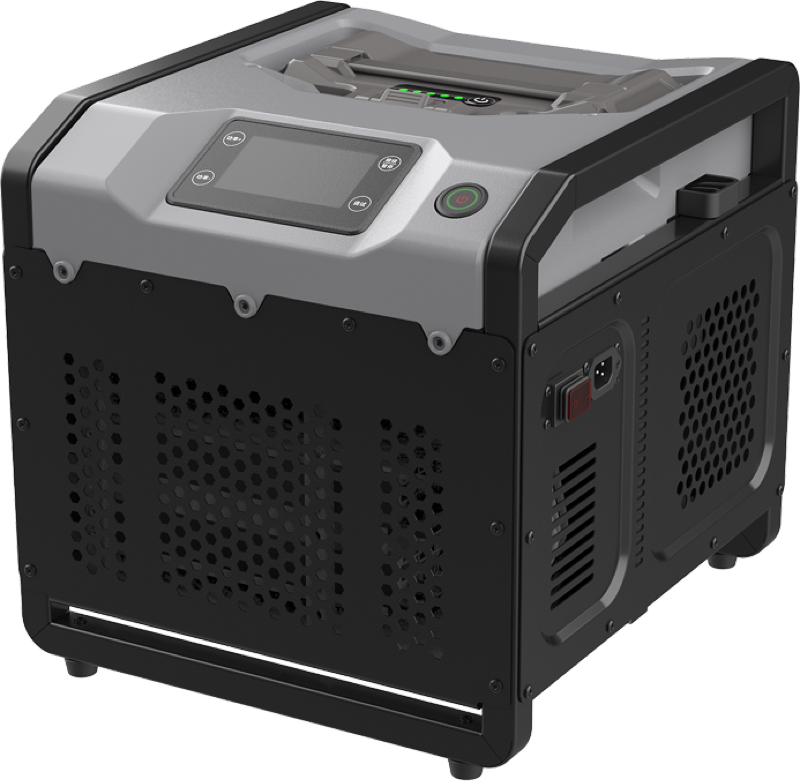
The 18S12000W intelligent supercharger is described with three-phase 380 V input and adaptive power protection. The overview also lists AC 100–240 V / 380 V charger input; your supplied charger and available power source need to be matched explicitly.
The overview lists approximately 8 minutes from 30% to 95%; the battery section lists approximately 10 minutes from 25% to 95%. These start at different charge levels. Confirm compatible charging equipment, supply power, battery temperature, and operating conditions.
Component images: Ceres Air. Images illustrate the manufacturer’s platform; confirm the equipment included in your AerSol proposal.
Specifications below are transcribed as technical facts and organized from Ceres Air’s platform page, reviewed October 29, 2026. Manufacturer figures can vary with configuration and conditions.
| Specification | Manufacturer-listed information |
|---|---|
| Rotor arrangement | 4 axes / 8 propellers; coaxial dual-rotor structure |
| Unfolded dimensions | 152 × 147 × 43 in (arms and blades unfolded) |
| Folded dimensions | 51 × 50 × 43 in |
| Maximum takeoff weight | 641.5 lb in the specification table (approximately 641 lb in the headline) |
| Maximum payload / lifting rating | 396 lb in the specification table; descriptive copy rounds to 397 lb |
| Maximum speed | 66 ft/s (approximately 45 mph) |
| Maximum thrust per axis | 375 lb, manufacturer-listed |
| Propellers | 70-inch carbon fiber |
| Motor / ESC figures | 187 lb maximum thrust per motor; 350 A electronic speed controllers |
| Specification | Manufacturer-listed information |
|---|---|
| Spray tank | 40 US gal |
| Advertised coverage | 100 acres/hour |
| Advertised area per flight | 20 acres |
| Spray flow | Up to 18 gal/min in the headline; 11 GPM in the spraying feature description — confirm configuration |
| Maximum spreading rate | 551 lb/min |
| Spray nozzles | Four atomizing centrifugal nozzles; rear four-nozzle array |
| Droplet range | 0.002–0.02 in (2–20 mils; approximately 51–508 microns) |
| Flow monitoring | Two electromagnetic flow meters |
| Obstacle-awareness sensors | LiDAR, 360° millimeter-wave radar, and rear-facing radar |
| LiDAR sampling | Up to 300,000 points/second |
| FPV camera field of view | Horizontal ±45°; vertical ±85° |
| Maximum image-transmission range | 2 km |
| Standard lifting cable | 15 m |
| Specification | Manufacturer-listed information |
|---|---|
| Controller display | 6-inch display; table names HD402, controller section names RC8P — confirm supplied model |
| Controller operating time | Approximately 7 hours; table states ≥7 hours and controller copy states up to 7 hours |
| Controller power arrangement | Internal battery plus two external batteries, as described by Ceres |
| Controller visibility & controls | High-brightness screen (Ceres describes a 25% brightness increase); backlit and customizable physical buttons |
| Flight-battery platform | 18S / 2,565 Wh; Ceres describes the platform as Dual 18S2565Wh |
| Battery capacity | 38 Ah |
| Listed battery weight | 37 lb |
| High-power charging current | 140 A |
| Battery cooling | Triple air-channel cooling architecture |
| Charge window in overview table | 30% to 95% in approximately 8 minutes |
| Charge window in battery section | 25% to 95% in approximately 10 minutes |
| Manufacturer cycle statement | 1,500 charge cycles under warranty; applicable terms require confirmation |
| Charger input in overview table | AC 100–240 V / 380 V; confirm charger and site-power configuration |
| Intelligent supercharger | 18S12000W; 12,000 W output, three-phase 380 V input, adaptive power protection |
Understand your operation, challenges, and goals.
Determine the right system and configuration.
Build and deliver your complete system.
Build the knowledge and confidence to operate safely.
Ongoing parts, service, guidance, and room to grow.
Request an itemized proposal covering the aircraft, payload modules, batteries, charger, field-support needs, delivery expectations, and applicable warranty arrangements. We confirm what is included and what is optional.
Tell us about your acreage, application needs, intended materials, available power, and location. We can then discuss the appropriate demonstration and a practical package for your work.